
I was speaking with a colleague the other day after another predictable government U-turn and we came to the conclusion that Britain is becoming ungoverable.
Since 2016 there have been 6 Prime Ministers, 8 Chancellors, 9 Foreign Secretaries, and 10 Home Secretaries. Not even stepping down to the Ministers of State where there has been even more change, with there being 17 Ministers for Housing.
Some would argue that this is just the political instability of the Tories. However, I would argue that instability mirrors the instability in the country.
Brexit, now almost 10 years old, threw a wrench into typical party lines, with both the Conservative and the Labour parties damaged by its influence.
Then the resulting oscillation from the Boris Johnson majority to the Keir Starmer majority - built on one of the lowest voter percentages ever - shows an electorate that can’t quite make up their mind. Their only objective is change. Further evidenced by the surge of third parties threatening the two-party system.
Take for instance the below voting intentions: at the end of 2025. There were 5 parties within 10 points of each other with the predicted seat counts below.
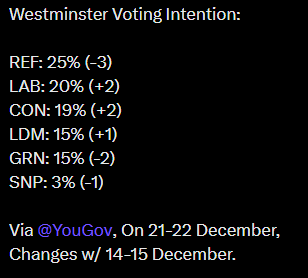
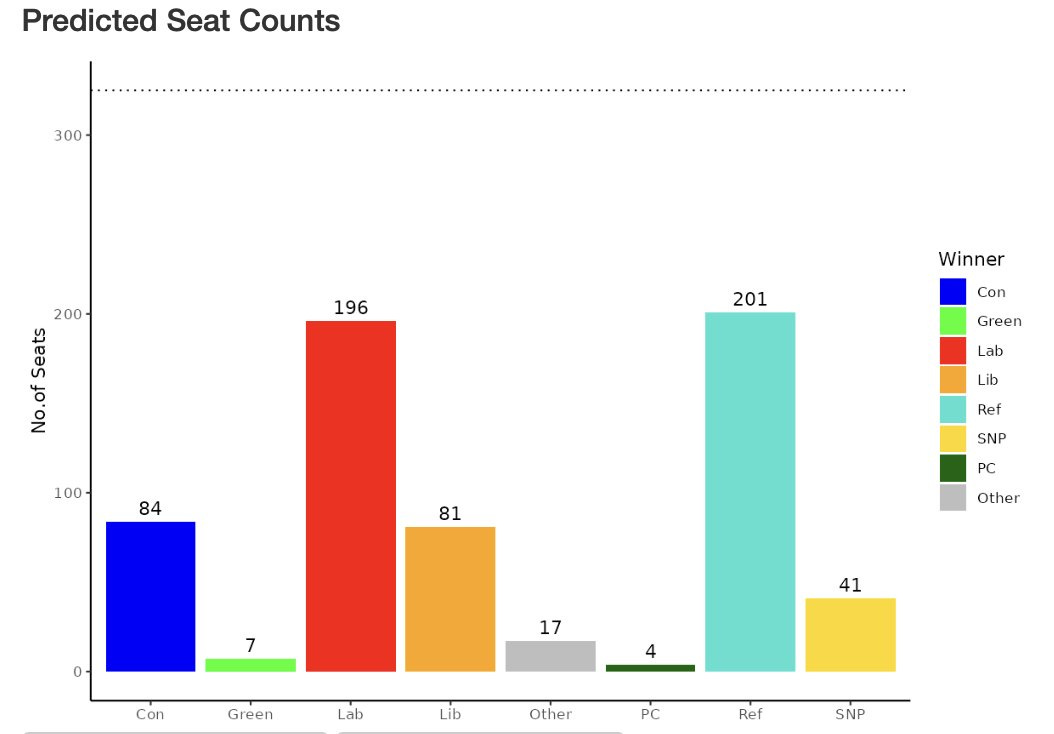
The First Past the Post system just isn’t built for this level of mixed voting; certainly the Westminster system as it currently exists isn’t. The above predicted seat count would result in either a 5-party coalition required for the left - made up of Labour, Lib Dems, SNP, Greens, and Plaid Cymru (depending on independents) or a bizarre Reform, Conservative, and Lib Dem coalition. Both of which seem highly improbable and extremely unstable.
The ungovernable nature of the UK is evident in the 13 major U-turns the Labour Government has performed only 18 months into office. From WASPI compensation to Income Tax, Welfare, and Farmers, to just today, Digital ID, the Government has been forced to step back on its policies.
The Labour backbenches are already exerting power as if it were the dying days of a government. They know how unpopular the party is with the electorate and they know how unpopular the Prime Minister is. Keir is currently polling at a –66% net satisfied rating - The lowest since Thatcher.
Politics has become far more about instant satisfaction and change - see the response to the Labour defeat in Caerphilly where Labour MPs reacted reflexively to change their Prime Minister.
No one, Labour or Tory, has come up with a credible plan to restrain public spending or to persuade the voters to accept the reality that taxes will have to rise. And no one knows how to stop the boats.
This is also true of Nigel Farage, who has finally done away with some of his more ridiculous tax and spending policies but has still failed to produce a substantive manifesto. This is obviously because it will fracture his supporters - many of whom are already disillusioned by decisions to admit former Tories such as Nadhim Zahawi or Ben Bradley.
Some would argue this is because of the quality of MPs. “We have useless MPs” - mostly true. Or they would blame the lazy civil servants - not true in my opinion. But frankly, I think the fault is because too few politicians are treating the electorate like real adults.
The economy is dire, public services are crumbling, and productivity and GDP haven’t really increased in 15 years. There are obviously going to have to be serious spending cuts alongside tax changes. But no politician wants to bite the bullet.
Because to suggest reforming the NHS to a social insurance system following nearly every other European country, or benefits, or removing the triple lock, would almost guarantee the loss of a political career.
Frankly, the problem is that the voters expect the impossible of their politicians. In essence, they want American taxes and Nordic welfare.
If Starmer does go, how long will the next Prime Minister last before we are in the same situation?