
The other night I was asked, “So, what about Greenland?”
Currently, Trump is trying to wage economic war upon a multitude of European powers as an attempt to exert pressure upon the Danish Government to hand the territory over and to punish European partners for attempting to pressure the negotiations.
Most ask why Trump is so interested in Greenland. The interest is threefold.
Firstly, Greenland possesses a prime position in the Arctic. The traditional Mercator projection provides a poor perspective.
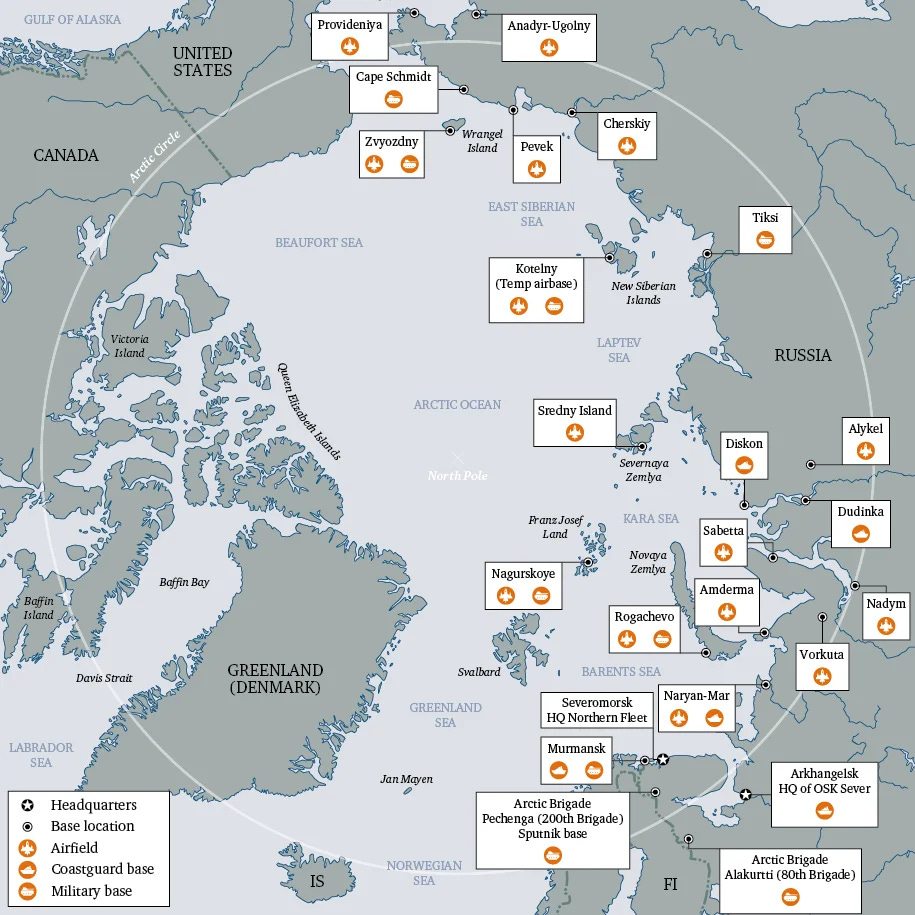
In the map above, you look down upon the Arctic and immediately the fear of the Americans becomes understandable.
The Russians for decades have been posturing in the Arctic with a significant buildup of military bases. Based on a report by The Simons Foundation in Canada, Russia has 32 “continuously attended military sites” in the Arctic region as of 2024. Norway has 15 “continuously attended military sites,” while the U.S. has 10, Canada eight, Denmark three (situated on Greenland) and Iceland one.
Whilst NATO as a whole has more sites than the Russians, the view from the White House is that America will have to operate independent of its allies to protect itself. Therefore, they see Greenland as a vital staging ground for any potential Arctic conflict.
This is further heightened by climate change, which has enormous ramifications for the defence of the region. As raised by the defence think tank RUSI, Russia relies on the cover of Arctic ice and background noise to protect its nuclear submarines. However, climate projections suggest ice-free summers by 2050; this will therefore require escorts and patrols to ensure security in the water. To project power in the region there will need to be adequate infrastructure in the form of permanent bases and Greenland provides the perfect location for the Americans to exert control over the region.
Furthermore, for the Americans, control of Greenland will allow them to have control over shipping routes currently used by Russian “shadow fleet” ships — something of key concern after their capture of the Marinera off the coast of the UK.
The second angle of importance for the Trump administration is mineral wealth.
As Greenland melts, its natural resources have become more accessible. Greenland has a large untapped potential for critical raw materials – including the rare earth metals graphite, niobium, and platinum group metals. Most of which are very important for the green transition, and a point of contention for the Trump administration as the US is currently reliant on the Chinese for most of these rare earth minerals.
Additionally, Greenland is believed to have huge untapped oil and gas reserves. In 2008, the estimate was approximately thirty-one billion barrels of oil equivalent — if Greenland was its own state, it would have the 12th highest reserves of oil.
There are huge difficulties in extracting this mineral wealth, though. The vast majority of Greenland is an ice sheet; only 20% of the island is ice-free, consisting of craggy mountains and fjord-cut cliffs. Beyond the few towns that exist, there is little infrastructure, with no roads or railways outside of settlements. Exploration has to occur via plane or boat.
This is further exacerbated by both the difficulty of mineral exploration and mining itself. As Simon Jowitt, director of the Ralph J. Roberts Center for Research and Economic Geology, notes, for every 100 mineral exploration projects, only one might turn into a mine. Beyond which, the progression from discovery to production can be 10 years — with delays highly probable in Greenland due to the aforementioned lack of infrastructure.
The third angle for the Trump administration is that of trade.
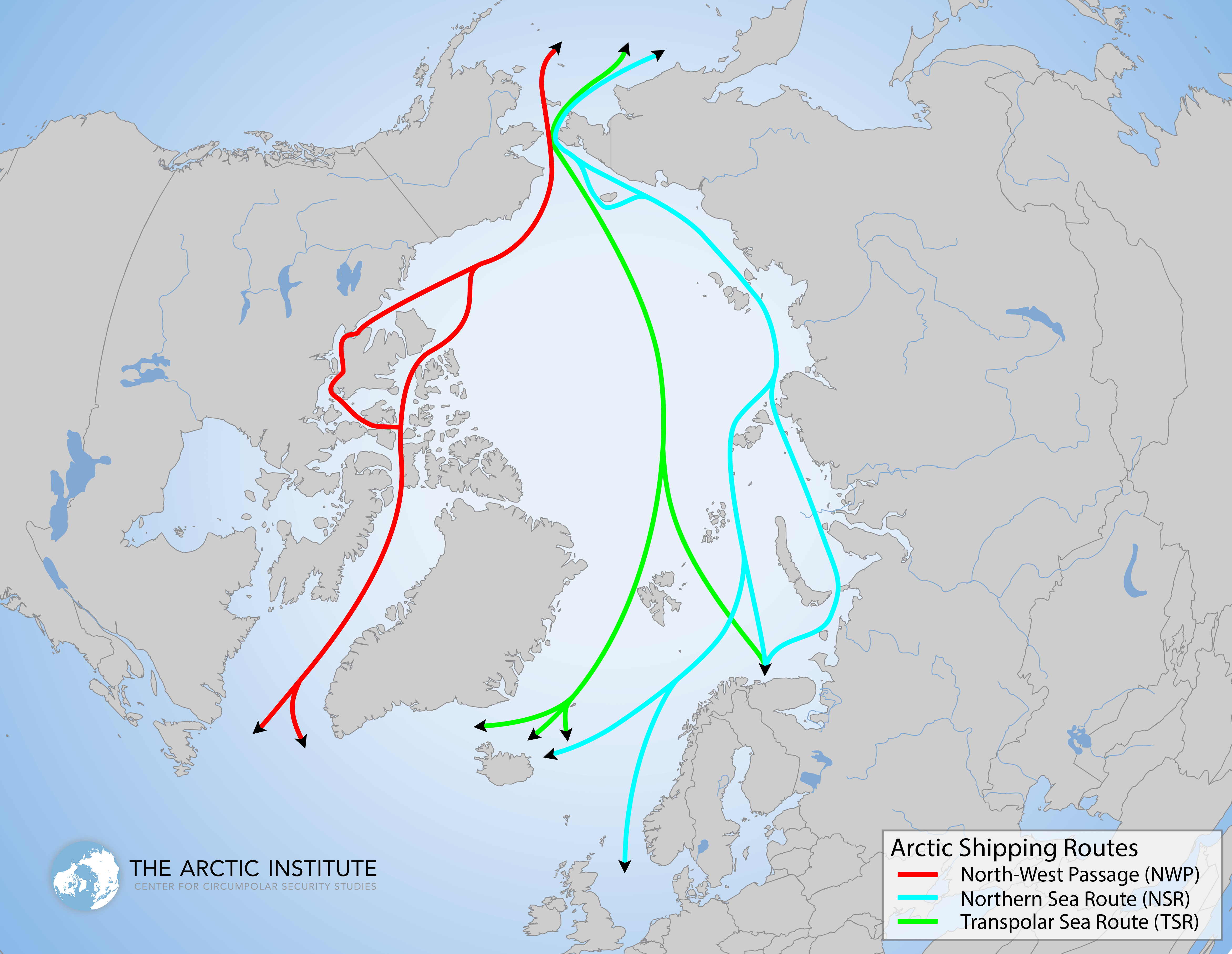
Above is the map of the three major Arctic trade routes.
Currently, only the Northwest Passage and Northern Sea Route are in use. The Northwest Passage faces thick multi-year ice and complex straits that make navigation especially challenging. Whereas the Northern Sea Route is relatively easier owing to lower overall ice extent and open water in the Barents Sea. Unlike similar latitudes in Alaska or Canada, this area remains ice-free due to currents of warm water from the Gulf Stream.
The economic value of either is clear. A usable sea route would cut time at sea and fuel consumption by more than half for trips between Northern Europe and North Pacific ports. It also significantly reduces reliance on the Suez Canal, saving on payments, queues, risk of piracy, and obstructions such as the Ever Given in 2021.
The geographic position of Greenland puts it in a prime position to act as a trade hub in the eventuality that the sea ice reduces so much that the Transpolar Sea Route becomes viable.
Currently considered a highly fringe route as it requires heavy icebreakers, the Transpolar Sea Route would provide the most direct path. While Northern Sea Routes decrease sailing times between Europe and East Asia from 30 days through the Suez Canal to 18 days, the Transpolar Sea Route provides even more time savings by cutting an additional one to five days from the journey.
Additionally, the Transpolar route passes outside the exclusive economic zones (EEZs) of Arctic coastal states, in comparison to the other routes that weave intimately through multiple EEZs.
For the Americans, there is a further fear of the Chinese getting involved in the region. China currently calls itself a “near-Arctic state” and is seeking to increase its economic and military role there. China has four icebreaking vessels, compared to Russia’s roughly forty and the United States’ one.
The American administration is therefore fearful of Canada’s vulnerability to the Chinese and the Russians in the Arctic, as Trump is concerned about what he sees as Canada’s inability to defend its borders, arguing that they need to spend more money on defence.
Recent reports by the Prime Minister of Canada, Mark Carney, about there being “much alignment” between the Canadian view of Greenland and the Chinese will only alarm the Americans more.
Whether the Americans eventually wrestle control of Greenland from Denmark is a different question. But the reasons for wanting the island are clear.